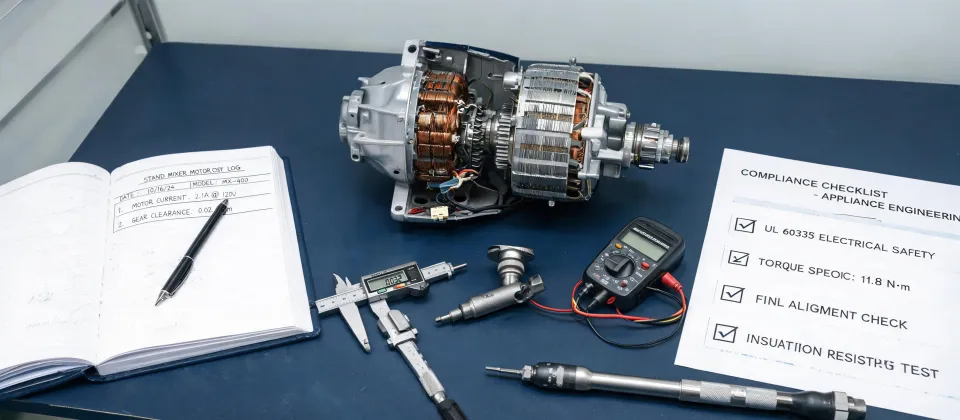
Last April I was standing in a client's kitchen holding a blender jar that wouldn't thread. The box said KitchenAid K400. The sticker on the base said K400. The parts diagram on the manufacturer's site listed this exact jar for that model. It wouldn't go on.
The client had already been through it once. They'd ordered a KitchenAid K400 blender jar replacement from a marketplace seller, waited nine days, and got a jar that seated about a quarter turn before binding. So they did what anyone would do and assumed they'd messed up — wrong part number, wrong search, wrong seller. Tried again. Different seller. Same result.
I've been on the receiving end of appliance deliveries for about eleven years, and for the last four I've been the person who signs off on them. Roughly 300 items a year move past my bench, and in 2024 I rejected close to a fifth of first deliveries for spec mismatches. Almost none of those were customer errors. They looked like customer errors. That's a different thing.
Most of the time the problem isn't the part, the seller, or the buyer. It's that the spec you're shopping against doesn't describe the thing you actually own.
Why the Spec Sheet Stops Matching the Product
Here's what nobody tells you at the point of sale: a model number is a family name, not a version number.
Model numbers aren't versions
The K400 has been in production long enough to have gone through more than one pass at the tooling. I can't prove what happened inside their factory — I don't have access to their drawings. What I do have is five jar assemblies on a shelf that look identical, four of which thread onto our test base and one of which doesn't. Same model number on all five.
The version marker you actually want is the serial number, and usually the date code stamped near it. Parts desks ask for the serial because it's the only thing that maps to a specific build. Order by model number alone and you're rolling dice and calling it shopping.
'16 cubic feet' is a marketing number
The same drift applies to capacity. A Maytag 16 cu ft convertible chest freezer is sold as 16 cubic feet, and that figure isn't a lie — it's gross volume, calculated in a way that doesn't care about the compressor hump, the baskets, the wall thickness, or how a real person stacks frozen food. What actually goes in is meaningfully less than 16 cubic feet. And 'convertible' means the same cabinet runs in fridge or freezer mode depending on the setting, which changes both usable space and how quickly it recovers temperature.
So measure twice. Exterior dimensions from the specification PDF, not the product page. Door swing. The hallway the thing has to get through. I watched two freezers go back last year because they fit the alcove and not the corridor (this was a condo building with a 29-inch turn — measure the turn).
Cooktops are the other classic. A KitchenAid electric stove top — search it as stove top or cooktop, listings use both — will publish a cutout dimension that's sometimes rounded in the marketing copy while the real number sits in the installation guide. I've measured cabinets where those two numbers were a quarter inch apart. A quarter inch is nothing. A quarter inch is also the difference between a cooktop that drops in and a countertop that gets recut.
While you're in that PDF, check the electrical spec too. Voltage, amperage, breaker size, the wire gauge the install guide calls for. The rating plate on the unit is the final word. Not the box.
Dates get revised, too
It isn't only hardware. Food safety guidance drifts the same way, and this is the version of the problem that can actually make somebody sick. 'How long is tomato paste good for in the fridge' gets asked so often because the can doesn't answer it. USDA FoodKeeper guidance puts opened canned tomato paste at roughly five to seven days refrigerated — but check the current version, because those windows get revised. Tube paste runs on a different clock. Unopened cans are a different answer again, and the best-by date is about quality, not safety.
Two practical notes. Get the paste out of the can once it's open; acidic tomato sitting against bare metal is a flavor problem even when the food is still safe. And if it's been in there two weeks and you're not sure, a half-can costs a dollar. Throw it out.
What the Mismatch Actually Costs
Individually, none of this looks like much. A jar, a return label, a quarter inch. Stack it across a kitchen and it stops being small.
Our own numbers: about five hours of staff time a week goes to parts verification and returns, which at our loaded rate is a little over $9,000 a year. That's before the appliance-level failures. The expensive ones aren't returned parts — they're the installations that went ahead on bad numbers (like a wrong cutout, a wrong breaker, a wrong door clearance). A recut countertop runs several hundred dollars depending on material and shop. Verify that number locally; stone pricing varies more than any spec sheet admits.
I'll own one of those. I knew I should have made 'model and serial' a hard requirement on every material requisition, but we'd been buying from the same distributor since 2019 and it felt like busywork. (Note to self, from back then: this is exactly the kind of shortcut that looks free right up until it isn't.) Then a rush order came through for a client tasting event with about 36 hours of runway. Normally I'd pull the install guide and cross-check against our test unit. There was no time, so I went with our usual vendor on trust — and got the one jar assembly in five that doesn't thread.
My honest ambivalence about it: part of me wants to say the distributor should have flagged the mismatch, since they had the serial on the original order. Another part knows we didn't give them a serial for the replacement, because I didn't ask for it. That's on me. The field is on the form now. The fix came after the mistake, like most of them do.
And the cost that never shows up on an invoice: every mismatch teaches the person in the kitchen to trust their own eyes a little less. That's a bad habit to train into anyone. The spec isn't the thing. If the part doesn't fit, it doesn't fit, no matter what the diagram says.
What I'd Actually Do
The fix is short, because the problem is already clear.
- Order parts by serial, not model. Give the parts desk the serial number and the date code off the rating plate. If a seller advertises a part as fitting 'all K400 units,' that's a signal to double-check, not a convenience.
- Pull the installation PDF. Not the product page, not the hero image, not the marketplace listing. The install guide is where real dimensions and electrical requirements live.
- Measure your own thing first. Cutout, clearance, door swing, breaker. Write the numbers down before you shop.
- For food, use a current source. USDA or FDA, checked this year. Guidance from 2019 isn't wrong because it's old — it's wrong because it may have been replaced.
There are manufacturers who go the other direction on this, and it's worth knowing what that looks like. The Espro P7 french press publishes its filter spec — dual filter, metal mesh plus a fine secondary layer — and the unit in the box actually does what the spec reads like. That's not generosity. That's a company treating the spec sheet as a promise instead of a suggestion.
None of this is new. Verify the thing, not the label. What changed is how easy it's become to skip that step, because now the label is everywhere — search results, marketplace titles, summaries — and the actual spec is buried in a PDF almost nobody opens.
Most of the specs I've rejected in the last two years were technically compliant. That's the whole problem.
I keep that line taped above my bench. It's there because the spec compliance report told us everything was fine, right up until the jar wouldn't thread.

Ask for sourcing context