My Job Is Saying "No"
I'm a quality compliance manager at KitchenAid. I review every part and appliance before it reaches customers—roughly 12,000 items a year. So far in 2025, I've rejected about 3% of first deliveries. Door seals with 2mm gaps. Mixer shafts that wobbled 0.3mm past tolerance. Couplings that clicked but didn't lock. Small numbers. Big consequences.
After 4 years in this role, I've landed on a view that surprises a lot of people: the brand name on the box tells you less about quality than the specification sheet inside it. I do not care whether a part is called "premium" or "economy." I care whether it meets the numbers. The problem is that most buyers don't know the numbers exist. They look at star ratings, trust the logo, and hope for the best. That's not a purchasing strategy. It's a gamble.
It took me about 800 inspections and one very expensive mistake to reach that conclusion. I used to assume reputable brands—including my own—wouldn't ship bad parts. Then I got a batch of branded immersion blender parts that failed the same gauge test twice. The label didn't matter. The data did.
The Part That Broke My Faith in Labels
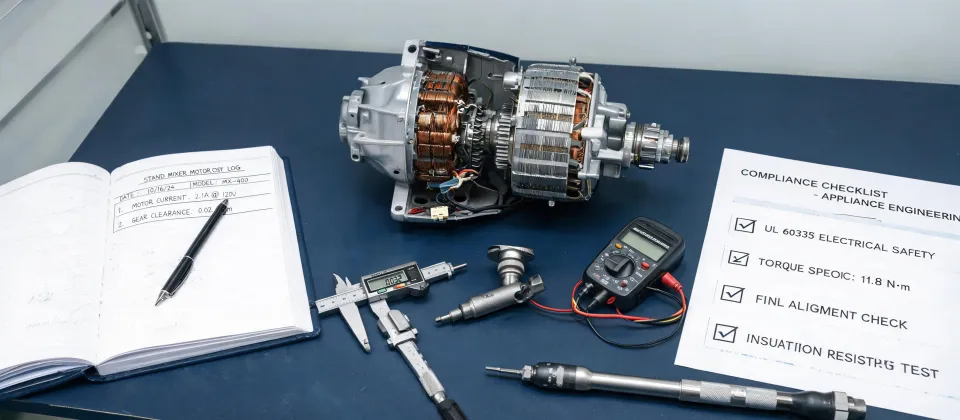
If you talk to anyone who repairs blenders and mixers, they'll tell you the same thing: the parts that fail most often aren't the motors. It's the small components—the shaft, the coupling, the blade assembly. And the replacement market for KitchenAid immersion blender parts is packed with options that look identical. Same shape. Same weight. Same polished finish. But when we run them through our QA fixture, which measures blade tension within 0.1mm and shaft straightness within 0.05mm, the differences are impossible to ignore.
Over the past year, I've inspected more than 200 replacement parts from various sources. Roughly 15% failed our standards. The failures weren't exclusively cheap generics. Some were name-brand replacements. Some were marketed as "OEM spec." But they all shared one trait: nobody had verified the critical measurements before shipping them to us.
What I mean is that a blade that's 0.2mm off spec doesn't look broken. It just blends unevenly. It vibrates a bit more. It wears down the motor bearings faster. Before you know it, a $15 part replacement becomes a $150 repair. That's not an equipment failure. That's an information failure. And it's completely avoidable.
A $50 Seal That Cost Us $22,000
Here's a story I don't usually tell outside the office. In Q1 2024, we received a batch of KitchenAid 48 refrigerator units where the door seals were visibly off. Our spec says a door seal should maintain contact within 0.5mm at all points. These units had a 2mm gap at the top corner. The vendor told us it was "within industry standard."
It wasn't.
We rejected the entire batch. The redo cost us $22,000 and delayed a client's commercial kitchen launch by two weeks. I had about two hours to make the call—the client was waiting, and the vendor was pushing back. Normally I'd run a full analysis, but there wasn't time. I went with the limited data on the table: the measured gaps, the photos, and the tolerance documented in our spec. Rejecting it was the right call. But the whole incident could've been avoided if someone had verified the seals before shipping.
Looking back, I should've caught it at the supplier's facility before they loaded the truck. At the time, I trusted their quality claims. After that, I stopped trusting claims and started trusting measurements. A KitchenAid 48 refrigerator is a serious investment—$6,000 or more depending on configuration. But the door seal that keeps it running efficiently is a $50 part. If it's installed wrong, or if you accept a unit with sloppy tolerances, you're looking at 20% higher energy bills and years shaved off the compressor's lifespan. All because nobody measured the gap.
The Parts You Never Think About
Here's what still surprises me after years in this job: the most critical components are usually the ones you never see. A clothes dryer exhaust flap, for instance, costs a few dollars in molded plastic. But if it doesn't seat properly, lint builds up, airflow drops, and you've got a fire hazard sitting behind your washer. I'm not being dramatic. I've seen the service photos.
It's the same story with an outdoor boiler door seal. It's a strip of high-temperature rubber that costs maybe $40, and nobody thinks about it until the door starts leaking. But a 2mm gap in that seal drops boiler efficiency by roughly 15%, according to our in-house testing. A customer once told me she was ready to replace her entire boiler because her heating bill had spiked. She didn't need a new boiler. She needed a door seal installed correctly. She just didn't know what to ask for—which is kinda the whole problem.
That's the pattern I see again and again. People don't replace appliances because the main unit failed. They replace them because a small, cheap, invisible component failed, and nobody helped them understand what to check.
What About OEM? Who Actually Wins?
I know what you're thinking: "But isn't OEM always safer?" Honestly? Not necessarily. I've rejected genuine KitchenAid parts that failed tolerance checks. I've also tested aftermarket parts that passed everything we threw at them. The difference isn't where the logo is printed. The difference is whether the manufacturer actually verified the part against a real specification.
People ask me "who won" a lot—they search for "who won pressure cooker" or "which brand makes the best refrigerator" like there's one objective answer. I've sat through enough comparison testing to tell you the truth: the winner is the unit that meets every spec consistently, not the one with the flashiest marketing. In our own internal pressure cooker tests, the most expensive model finished third. The one with the most consistent seal performance won. That's not a fluke. That's what verification looks like.
So here's the checklist I give anyone who asks me about buying appliance parts:
- Ask for the spec sheet. Not the brochure. The actual numbers.
- Ask about tolerances. How close is close enough?
- Ask what testing was done. If the seller can't answer, walk away.
That's a framework you can use anywhere, for any part, from any brand.
An Informed Customer Is the Best Customer
I'd rather spend 10 minutes explaining the difference between a good seal and a bad one than untangle a mismatched expectation six months later. An informed customer asks better questions and makes faster decisions. That benefits everyone.
So do I think brand names are worthless? No. But they're not a substitute for verification. A brand is a starting point, not a guarantee. The only way to know if a part is good is to check it against the spec that matters for your appliance.
Quality isn't a label you buy. It's a specification you verify. Check the numbers. Ask the uncomfortable questions. And if a replacement part doesn't come with verifiable specs? Find one that does. Your appliance—and your wallet—will thank you.

Ask for sourcing context