The pallets arrived on a Tuesday in March 2024. Twelve of them, wrapped in stretch film, sitting on the loading dock of a 120-room hotel that was supposed to open in six weeks. I'm the quality and brand compliance manager for the management company. I review every appliance order before it hits a property—roughly 200 unique SKUs a year across eight hotels. In Q1 2024, I'd already rejected 14% of first deliveries for spec or documentation issues. I was hoping this Cuisinart order wouldn't be number fifteen.
It almost was.
The order, and why we picked Cuisinart
The hotel needed a full kitchen equipment package: coffee makers for the breakfast station, immersion blenders for the prep kitchen, cookware, slow cookers, air fryers, ice cream makers for the dessert program, toasters, kettles. We went with Cuisinart for three reasons. Range—they cover everything from a drip machine to a specialty ice cream maker under one brand. Durability reputation. And, frankly, the after-sale support. Replacement parts, instruction manuals, service documentation—Cuisinart manuals are easy to find and easy to read. For a B2B buyer, that's not a small thing.
The total ticket was $47,200.
What we caught, and what almost slipped through
The manual problem
First flag, and it came early. We required Spanish-language manuals for the coffee makers and immersion blenders. Roughly 60% of the kitchen and housekeeping staff reads Spanish as a first language. Manual de cafetera Cuisinart en español wasn't a nice-to-have—it was a training requirement. If the breakfast crew can't descale a coffee maker because the instructions are in English, you get scale buildup, and scale buildup kills machines in months, not years.
The English Cuisinart manuals were in the box. The Spanish versions were \"available upon request.\" I'd assumed that meant \"included in the shipment.\" It didn't. It meant \"we'll send them later.\" Later turned into three weeks. Staff training got pushed back twice.
I knew I should have put the exact manual language requirement in the purchase order. But I'd worked with this vendor for three years, and I thought, \"They know our requirements.\" That was the one time it mattered. The Spanish coffee maker manuals arrived incomplete—missing the descaling section entirely—and we had to have our own team translate and print the pages. Embarrassing. Fixable, but embarrassing.
The spec deviation
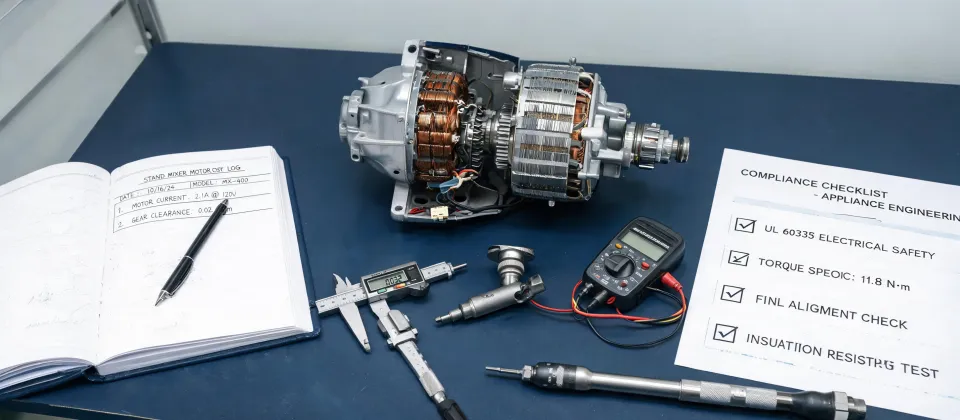
Second flag, and this one was more serious. We'd specified a blade housing tolerance of ±0.3mm on the immersion blenders against our standard. Normal tolerance for the category runs a little wider, but we'd tightened ours after a batch failure in 2022 had cost us a $22,000 redo. I measured the first three units. They were off by 0.8mm.
The vendor's rep said it was \"within industry standard.\" We rejected the batch. They redid it at their cost. Simple as that—but only because we measured. If we hadn't, those blenders would have gone into service and the bearings would've failed within six months. Then we'd be doing warranty claims instead of opening a hotel.
The blind spot
Here's what I almost missed. Most buyers focus on the appliances themselves and completely miss the water going into them. We were spec'ing a coffee program with Cuisinart machines running 200+ cycles a day. Without proper water treatment—specifically, the best under counter reverse osmosis system we could find for the space—those machines scale up inside of six months. The descaling instructions in the Cuisinart manuals show you how to clean a scaled machine. They don't prevent scale in the first place.
We hadn't included an RO system in the original order because it's not a Cuisinart product. That was our gap, not theirs. Adding it cost $3,200. It would've cost us $8,000+ in machine replacements over three years without it.
The WiFi question
While we were at it, our facilities lead had ordered smart switches for the kitchen lighting and ventilation. WiFi-dependent ones. In a commercial kitchen. Where the router lives in the manager's office behind two fire doors. They dropped connection twice in the first week.
Does a smart switch work without WiFi? That's a question we should've asked before ordering, not after. The \"WiFi is everywhere\" thinking comes from an era when residential smart homes were the only use case. In a commercial kitchen, you need switches that fall back to local control when the network goes down. We swapped them out at an extra $400. Not a huge line item, but a preventable one.
The housekeeping question
Separately, housekeeping had been evaluating robot vacuums for the hallway and lobby. Their internal midea robot vacuum review showed decent cleaning performance. But my job isn't to score performance—it's to ask what happens when something breaks. The Midea review didn't cover parts availability or service turnaround. For a hotel, those matter more than the initial score. Cuisinart's advantage in this procurement wasn't just product quality. It was that they stock replacement parts and manuals as part of their standard support. That's not something to take for granted—and we didn't.
What it cost us
Let me put numbers on it, because numbers are honest.
Rejected immersion blender batch: zero cost to us, but a two-week delay on the prep kitchen setup. RO system addition: $3,200. Switch replacement: $400. Manual translation and printing: roughly $300 and three weeks of my team's time. Total: about $3,900 and a month of calendar time we didn't have.
The lowest quoted price was not the lowest total cost. That's the thing about procurement—the invoice is just the beginning.
The honest limitation
I recommend Cuisinart for hotel and mid-volume commercial kitchens. I don't recommend it for every commercial kitchen.
Specifically: if you're running a 24/7 high-volume operation—a 300-room property with continuous breakfast service, or a restaurant doing 500 covers a night—the consumer-grade Cuisinart line probably isn't the right call. You'd want commercial-grade equipment or a different brand entirely. The right question isn't \"is Cuisinart good?\" It's \"is Cuisinart right for your volume?\" For a 120-room hotel with a 200-cover breakfast, we're in the sweet spot. For a high-volume operation, we'd be pushing the equipment past its design intent.
That's an honest limitation, and I'd rather say it out loud than pretend every appliance fits every kitchen.
Three things I'd do differently
One. Put manual language requirements in the contract. Not \"manuals included.\" Specific: \"Spanish-language Cuisinart manuals for coffee makers and immersion blenders, delivered with the initial shipment.\"
Two. Spec the water treatment before you spec the coffee equipment. They're the same decision. If you're buying a machine that runs 200 cycles a day, you're also buying an RO system. Budget for both.
Three. Resist the \"we've worked together for years\" complacency. That's exactly when things slip. Three years of good deliveries put me off my guard. The manuals were incomplete and I didn't catch it until the pallets were on the dock.
The hotel opened on schedule. Breakfast service runs 6am to 10am. The coffee makers have been descaling on schedule because the staff actually read the Spanish manuals—once we got them printed. And the immersion blenders? They're running fine. The ones we kept, anyway.

Ask for sourcing context