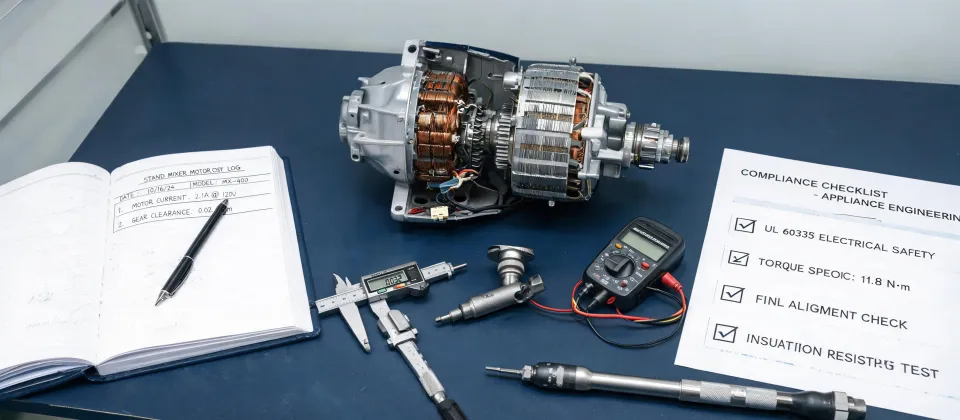
I'm not a decorator. I don't get paid to make kitchens look pretty. I get paid to stop things that will eventually fail.
For the last four years, I've worked on KitchenAid quality and brand compliance. I review roughly 200 unique units a year before they leave the building. In Q1 2024, I rejected 3% of first delivery units due to finish mismatches, hinge misalignments, and one control panel typo that I still laugh about. A lot of my time also goes to B2B buyers—hotels, commercial kitchens, restaurant groups—and their priorities are the same as homeowners: will it survive, and will it cause problems later?
So when I compare a standard kitchen to a built-in KitchenAid setup, I'm not taking sides. I'm looking for what holds up.
The Comparison Framework
Here's what I'm actually comparing:
Option A: A standard kitchen with a freestanding 36-inch refrigerator, a gas cooktop, basic smoke alarms, and an I'll-find-someone-when-it-breaks approach to repairs.
Option B: A built-in KitchenAid suite with a 42-inch built-in refrigerator, an induction cooktop, a smart home smoke alarm, and a documented service network for repairs.
I'll look at four dimensions: refrigeration, cooking energy, fire safety, and repair reliability. Each one ends with a verdict.
Refrigeration: 42-Inch Built-In vs. Standard Freestanding
People always ask me if a KitchenAid 42-inch built-in refrigerator is worth the price. That's the wrong question. The right question is whether your kitchen can actually support it.
A freestanding 36-inch counter-depth refrigerator gives you around 23 cubic feet, sits a few inches deeper than your cabinets, and can be swapped out in under an hour if it dies. A built-in 42-inch model gives you more interior space, usually in the 27-29 cubic foot range, and sits flush with the cabinetry. That flush fit isn't just cosmetics. It changes how the door swing works, how much counter space you keep, and how the kitchen feels in the morning.
Here's where I hit my data boundary. I don't have hard data on 20-year service costs for built-in units versus freestanding units. The sample size is too small. What I can say anecdotally is that most early failures we see in warranty claims are installation-related, not compressor-related. The unit goes into an unlevel opening, the hinge gets tweaked, a gasket leaks a few months later. That's a spec failure, not a refrigerator failure.
If you're planning a full renovation, the 42-inch built-in makes sense. You get the finish, the layout, and the efficiency of a flush kitchen. If you're simply replacing a broken fridge in an existing kitchen, don't build a custom cabinet around a refrigerator. A freestanding counter-depth model will do the job for a fraction of the cost.
Verdict: Built-in wins in a new kitchen. Freestanding wins as a replacement.
Cooking: Induction vs. Gas
This is the dimension where I sound like a convert, and I'm fine with that.
The most common spec question I get is 'how many watts does an induction cooktop use?' It's a bit like asking how fast a car can go. A typical 30-inch induction cooktop from KitchenAid pulls roughly 1,800 watts on a single high burner. If you're running two or three burners plus the boost function, you can get to 3,500-4,000 watts. It needs a dedicated 240V circuit, usually 40A or 50A. So this is not a simple plug-in swap for an old electric coil range.
Now let's talk about the gas stove harmful effects conversation, because it's usually framed in a misleading way. Gas stoves are not automatically dangerous. But they are combustion appliances. When you burn natural gas indoors, you create nitrogen dioxide and carbon monoxide. Lawrence Berkeley National Laboratory has measured indoor NO2 levels exceeding health guidelines in homes with gas stoves and no range hood. A hood that vents outside changes the picture completely. A recirculating hood may filter grease, but it doesn't fully solve combustion gas.
The efficiency math also favors induction. About 85% of the energy from an induction element goes into the pan. For gas, that number is closer to 40%. Yes, gas puts out great heat, but a lot of it goes into the air around the pan.
Here's the counterintuitive part: induction's total electricity use isn't as scary as the wattage number looks. Because the heat transfer is so fast, the burner is on for less time. A gas burner operating at 10,000 Btu per hour might deliver 4,000 Btu of useful heat into the food. An induction element pulling around 2,500 watts is drawing about 8,500 Btu per hour worth of electricity, but it delivers more useful heat to the pan with far less wasted room heat. So the answer to the wattage question is not the same as the energy-waste question.
Verdict: If you have a proper outside-venting range hood, gas can still be a legitimate choice. If you're starting from scratch or can't vent outside, induction is the more efficient and easier option.
Safety: Smart Home Smoke Alarm vs. Standard Alarm
A standard smoke alarm costs around $15, meets code, and does one thing well. A smart home smoke alarm costs $100 to $150, connects to Wi-Fi, and does several things: it detects smoke, speaks, sends a phone alert, and runs a self-test every month.
Which one belongs in a high-end kitchen? I'd lean smart, but not for the reason everyone expects. The phone alert is convenient, but the real value is the spoken message. Instead of a generic beep, the alarm tells you what it detected and where. In a kitchen, that's the difference between running around looking for smoke and already knowing it's the toaster.
The second benefit is the self-test. Traditional alarms get ignored. I wish I had tracked how many homes have a smoke alarm with a dead battery, because what I can say anecdotally is that every time I walk through a home, someone I know says 'oh, that one beeps when I cook.' A smart alarm can be silenced from an app, so you don't have to take it down and remove the battery. That means it stays functional longer.
Per NFPA 72, smoke alarms should be installed in every bedroom, outside every sleeping area, and on each level of a home. Smart alarms don't change the placement rules. They just make the alarms easier to live with.
Verdict: A basic dual-sensor alarm is fine if your Wi-Fi is unstable or you just need code compliance. A smart smoke alarm is worth it when you want fewer false alarms and better feedback.
Repairs: Professional Service vs. DIY
Let me paint a picture. It's 10 p.m. in Santa Monica, there's water under the dishwasher, and you're typing 'KitchenAid dishwasher repair Santa Monica' into your phone. The search results show three local service companies, two national chains, and a parts website. Which one do you call?
Not the parts website.
A few years ago, I assumed a dishwasher draining problem meant the drain pump was shot. Didn't verify. Turned out the air gap was blocked. A new pump cost about $180 plus labor, while a cleaning pick cost $4. That experience stuck with me. The reason a professional service call is worth it isn't that the technician is a genius. It's that they follow a checklist. A good repair tech checks the air gap, the drain loop, the float switch, and the error code before ordering an expensive part.
This is also a brand safety issue for me. When a KitchenAid dishwasher fails in the first year, the appliance itself is rarely the root cause. More often, it's an installation detail or an unauthorized repair that broke something else. If you're in the market for a KitchenAid dishwasher repair in Santa Monica, look for an authorized provider who uses genuine KitchenAid parts. Ask if the labor warranty covers a repeat of the same issue. And get the troubleshooting notes in writing.
Total cost of ownership matters here. The cheapest repair quote is not the lowest total cost if it means a second service call two months later.
Verdict: For anything involving water, electronics, or warranty coverage, hire someone properly. DIY is fine for a filter cleaning or a visible part replacement, but not for a mystery leak.
What I'd Choose
Okay, this is where I stop being neutral.
If I were doing a full kitchen renovation right now, I'd build it around a KitchenAid 42-inch built-in refrigerator, put in an induction cooktop, install a smart smoke alarm, and line up a service provider before I needed one. That's the efficient setup, and efficiency is a quality feature. It reduces wasted energy, wasted time, and wasted phone calls.
If I were replacing a broken appliance in an existing kitchen, I'd keep the freestanding fridge, keep gas only if I had a true outside vent, buy a standard interconnectable smoke alarm, and still pay a professional for dishwasher repairs.
One caveat: this works in my context, which is North American kitchens with enough space and a standard service network. If you're dealing with a 120V cooktop circuit or a rental apartment where you can't modify cabinets, the calculus is completely different.
I don't have hard data on your exact kitchen. What I can tell you from four years of approving and rejecting appliances is that the most impressive-looking choice is not always the best one. Choose the option that reduces repeat service calls, unnecessary energy waste, and avoidable safety risks. That's how I review every product, and that's what I'd bet my kitchen on.

Ask for sourcing context