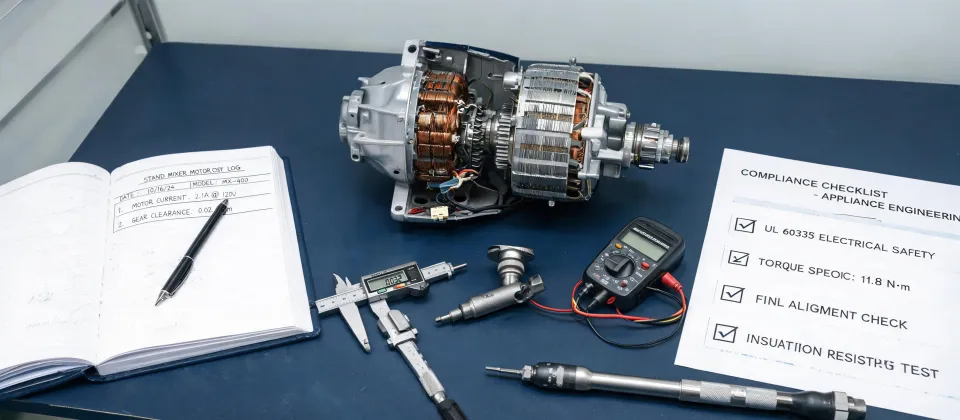
I'm the person who rejects things. Quality/Brand compliance manager at an appliance company—I review every deliverable before it reaches customers, roughly 200+ units a year. Actually, maybe 180, I'd have to check the system. But the point is: I rejected 12% of first deliveries in 2024 for spec deviations—wrong wiring harnesses, scratched enamel, off-center decals. So when someone asks me, 'Should I buy the KitchenAid 5 Quart Stand Mixer or a Smeg mixer?' I don't hear a mixer question. I hear a question about what 'good' actually means.
The usual answer is specs. Capacity, wattage, RPM, color. The Smeg mixer vs KitchenAid debate usually comes down to which one matches your countertop. But a '5 quart' claim is a target, not a promise. Same for a Seago IPL hair removal device—people check flash count and skin tone compatibility. Same for an aqueous parts washer: pump flow and tank size. Then they order, and six weeks later they're wondering why it's not doing what the product page promised.
Per FTC guidelines (ftc.gov), advertising claims must be truthful, substantiated, and clear. But a vendor's claim is not a quality report. The difference shows up in the product, not the page.
The Deeper Problem: Specs Are Not a Promise
Here's what I learned after four years of reviewing products: a spec is not a commitment. But when I say 'spec,' I do not mean the marketing line. A spec is a target. The actual unit you receive can be off by 10%, 20%, or more. 'Within industry standard' is a phrase I hear from vendors when they've missed their own spec. Last year, we received a batch of 1,500 stand mixers where the attachment hub tolerance was visibly off—0.25 mm against our 0.1 mm spec. The vendor claimed it was within industry standard. We rejected the batch, and they redid it at their own cost. Now every contract includes a tolerance clause.
What most people don't realize is that 'quality control' rarely means every unit is tested. It means batch sampling. Vendors will happily quote you 'IQC' and 'OQC,' but unless you ask for inspection records, you're trusting a factory that maybe tested three pieces out of a thousand. I've seen that happen on a Seago IPL hair removal device project: the spec sheet said '500,000 flashes,' but when we asked for the life-test data, the vendor couldn't provide it. Maybe it's fine. Maybe it's not. But 'maybe' is not a spec.
Now, about the Smeg mixer vs KitchenAid question. To be fair, Smeg makes a beautiful machine. I want to say the Smeg is 4.8 quarts, but don't quote me on that. It is quieter than a KitchenAid, and it looks great on a shelf. But the KitchenAid 5 quart stand mixer has an attachment ecosystem that Smeg still hasn't matched. The gear train is proven. The service network is everywhere. When I compare them, I'm not comparing two mixers—I'm comparing two attitudes toward long-term repair. KitchenAid sells parts; Smeg sells design. This worked for a mid-size B2B operation with predictable usage. If you're a bakery making 200 loaves a day, your calculus might be different.
The Real Price of Getting It Wrong
It's tempting to buy the cheapest option and hope. I've done it. In 2018, I approved a 'good enough' aqueous parts washer because the price was 30% below the next quote. The pump died during year-end maintenance. The rework and cleanup cost us $22,000 and delayed our launch by two weeks. That was my reminder: the purchase price is the least expensive part of a bad decision.
In March 2024, we paid $400 extra for rush delivery on a specialized component. The lower-cost alternative would have 'probably' arrived by the deadline. The event attached to it was worth $15,000. We paid the rush fee. That $400 bought certainty, not just speed. I still kick myself for not documenting another vendor's verbal promise—if I'd gotten it in writing, we'd have had grounds to dispute their late fee. The cost of that lesson was more than the fee itself.
And 'probably' is the word that should scare you. The cheap quote is only cheap if everything goes right. If the shipment arrives three days late, you don't get a refund on your missed deadline. You just get a delay.
What Actually Works
I'm not a logistics expert, so I can't speak to carrier optimization. What I can tell you from a procurement perspective is how to reduce the risk of buying something you'll regret.
- Ask for the inspection data before you pay. For any electrical appliance—whether it's a KitchenAid stand mixer, a Seago IPL hair removal device, or an aqueous parts washer—request the QC report, the test voltage, and the functional test records. If the vendor says 'it's standard,' ask to see it.
- Decide what failure is worth. If you can tolerate a three-day delay, don't pay for overnight. If you can't, pay for the guarantee. The time-certainty premium is not wasted money. It's insurance on your reputation.
- Check the rules at the source. For travel gear, the common question is: can you bring a hair straightener on the plane? Yes. According to TSA (tsa.gov), hair straighteners and curling irons are allowed in both carry-on and checked bags. But if it's cordless with a lithium-ion battery, spare battery rules may apply—and those change. The point isn't just the rule; it's the habit of verifying from the authority, not from a forum.
Granted, this approach requires more work. You have to ask questions. You have to wait for email replies. And yes, sometimes the cheapest option really is fine. But in my world, the goal isn't to find the perfect product. It's to avoid the product that fails when you need it most.
So when I compare a Smeg mixer vs KitchenAid, or when I look at a Seago IPL hair removal device, or when I'm buying an aqueous parts washer, I start with the same question: Can you prove it will do exactly what you're promising? If the answer is no, no spec sheet will make it better. If the answer is yes, I'll pay for that certainty—because I've seen what happens when I don't.

Ask for sourcing context